Tuesday, June 30, 2015

Beyond Digital Natives

Chapter 10:
"There is no doubt that ICT and digital media have had a major impact on the ways in which young children today learn, play, work, and socialize."- Rachel Levy (Thomas, 2011, p.151)
This quote could be the summation of the whole book in a single line. I like this and with out a doubt I agree with it to the nth degree. I also feel this applies to young adults, as well as older generations. Technology has proved it is here to stay and if a person doesn't want to get left behind, they better just accept it and learn to love it.


Chapter 11:
"These results support the notion that technology is highly assessable and therefore potentially well-integrated into young people's lives."-S. Bennett & K. Maton (Thomas, 2011, p.171)
This line is talking about research that was done on digital natives previously mentioned in chapter 11. It is very easy to just look at a young person and think "yep, a digital native who knows all about this new form of technology" simply because they are young and because that seems to be the norm. There are many more factors that contribute to the digital native argument, including an individuals ease of access to and their want to use technology. I agree that there is the potential of technology being well integrated, but that is not always the case.


Chapter 12:
"Among other things, it is not enough to be born on a certain date in history and merely to have access to technology"- J. Palfrey & U. Gasser (Thomas, 2011, p. 189)
Again, I think this hits the nail on the head with how people make the assumption a person is a digital native based solely on their year of birth. Just because someone is born after a certain date and has access to what seems like endless information at their fingertips, that does not mean that they know all about it and utilize it to it's maximum potential. It's not true nor fair to just put that label on all young people.


In the reading, it mentions that 'digital natives' is a subgroup of the population, not an entire generation. I  agree with that statement. All people are different, all people learn differently, all people have different likes, and all people utilize the tools that they have in different ways. It wouldn't be fair to an entire generation to lump them together and call them one thing, and it wouldn't be wise for someone to assume it's ok to do so. 


The True Meaning
 

I choose to make this meme because after reading the text in it's entirety, I believe that you can't just simply label someone a digital native because of their age. It is easy for all of us to just make assumptions here and there based loosely on half facts. We just need to remember that we need to know the whole story. And with the term 'digital natives', there is more than what meets the eye.


Resources:
Thomas, M. (Ed.). (2011). Deconstruction Digital Natives: Young People, Technology and the New Literacies. New York, NY: Routledge.

Monday, June 29, 2015

Deconstructing Digital Natives Presentation


In my presentation, I take a closer look at the term 'digital native' and try to gain a better understanding of exactly what it means and who it is. Throughout the text, there are a few definitions and interpretations given of what 'digital native' means. The main thing that I took from this book, and that I hope to show through my presentation, is that there is no one exact definition that spans the entire population and fits every person who could be considered a digital native.

In the first few slides, I want to portray how technology is changing rapidly. Children are on the cutting edge of all these new technologies that didn't exist as little as five years ago. They don't even realize it, either. It's such a normal part of their lives now days, some children can't even remember a time before they know how to use the internet or mom/dad's iPhone.

Several studies that the book shows us brings to my attention that all over the world, people use technology for different things and in different ways. However, in the bigger picture, we are all humans, and I feel confident in saying that we all have similar uses for technology. Teenagers and young adults seems to use the internet more for communication and entertainment. This particular fact was true for the USA as well as the folks in Japan and the Nordic countries.

Another major point I discuss is learning. Everyone does it differently. There is no template that fits each and every one of us when it comes to learning. Factors in our lives also play a part in the way we learn, especially the way we learn and interact with technology. If a child is introduced at an earlier age, I do believe that they have a little leg up when it comes to learning and accepting new technologies. I also believe that a child can come from no technology in the home and excel when introduced to it later in life.

As far as technology and education goes, I don't think that there is one right answer. I do think that teachers should teach children how to use the technologies that they are expected to use in school. I also think that some of the responsibility has to be on the student to want to learn and better themselves so that they aren't left behind in this ever-changing, rapidly growing world of technology.

I liked the idea behind "moral panic"; but I truly believe that what you see is not always what you get. Just because a person fits the stereotype or the profile of a digital native, doesn't mean that they are a computer/ technology genius. It all has to do with what each person knows, what they want to know, and how much effort they put into knowing/learning. No one is just born knowing how to use Facebook or how to created a 20 slide PowerPoint presentation using two different programs.

To wrap it up, I do believe that you just can't that every person born after 1980 is a digital native. The text gives plenty of examples where someone born before that is just as, if not more, technologically inclined than me (by birth year alone, defined as a digital native) and plenty more of a so called digital native not living up to their name. It's unfair to everyone to label an entire generation as one thing and not take into account all our differences.

My last slide is easily my favorite. It reminds us to keep an open mind; and with that, we all can have hope and opportunities for a brighter future.

Tuesday, June 23, 2015

Digital Natives: Navigating Literate Worlds

Chapter 7:
"Not all young people are digitally competent, nor are they all interested in every aspect of the new media"-Ola Erstad (Livingstone, 2009 as cited in Thomas, 2011 p.99)
I agree with both parts of this line. Not all young people/students have the same opportunities so how can we expect them to all be digitally competent? Technically, I am a digital native, yet there are many apps and forms of technology and digital/social media that I know nothing about, nor do I have the desire (at least right now) to learn about them.


Chapter 8:
"It [the Internet] has fundamentally changed the ways in which activities and exchanges are carried out across sectors as divers and important as commerce and banking, entertainment, the arts, and education." -G. Kennedy and T. Judd (Thomas, 2011 p122)
This is true for my life, so I am sure that it is true for many other people as well. On-line banking has changed my life! As stated in a previous chapter, thanks to technology, we have changed the way we view television, movies, and music. In my Math class, more aspects than not are on blackboard and MyLabsPlus program, both online.


Chapter 9:
 "In Sweden more than half of five year olds are using the Internet and there are almost no non-users among teenagers and young adults." (Findahl & Zimic, 2008 as cited in Thomas, 2011 p.137)
This quote really surprised me. I have no knowledge of people in other countries use of technology, so to think that almost everyone (teens and young adults) in the entire country uses the internet was shocking. I think of people in America, and even just the people that I know... Not even close to all of us have or even use the internet.


Teachers & Digital Literacies:
The text mentions that "it is important to stress that digital literacy is related to situational embedding, that is, that use of technology with life situations" (Thomas, 2011, p.106). This seems to be especially true in my opinion. If a student's parents are able to provide them with technology at home at a younger age, then their life situation allows for them to be more acclimated to learning new things. If a student doesn't have this particular life situation, then perhaps they aren't introduced to any new technology until they make it to elementary school.

So to answer the question should teachers be responsible for developing digital literacies, I think both yes and no. Yes, because for some students, a teacher is the first person to introduce technology to them. So I do feel it is the teachers' responsibility to make sure that the students have the opportunity and the knowledge they need to be up to par with the technology used in their classroom for their grade level. I don't, however, think that it is up to teachers to teach students how to use Facebook, or Snap chat, or whatever the latest app happens to be.

I do think that developments in digital literacies can support the development of reading practices. Since not all reading is done via a text book, students can pick what they read based on their interests. This has the possibility to make students want to be a better reader because they are interesting in what they are reading. When it comes to writing, I feel that nothing is really going to beat the  practice of actually writing to improve. Practice makes perfect, and this especially holds true when it comes to writing.


I chose to make this meme because this recently happened for me. I had never heard of, let alone used, Google Docs or Google Slides. I think that this represents how the role of formal schooling plays in the development in digital literacies. Up until right now in my schooling, I did not need either of these applications of Google, but when I did, it was through Taskstream and YouTube that I learned how to use them.


 Resources:
Thomas, M. (Ed.). (2011). Deconstruction Digital Natives: Young People, Technology and the New Literacies. New York, NY: Routledge.
Wednesday, June 17, 2015

The Civic, Social and Multi Modal Lives of Digital Natives

Chapter 4:
"Digital Natives are used to receiving information really fast. They like to parallel process and multi-task. They prefer their graphics before their text rather than the opposite. They prefer random access (like hypertext). They function best when networked. They thrive on instant gratification and frequent rewards. They prefer games to 'serious' work." (Prensky, 2001a, p.2 as sited in Thomas, 2011, p.50)

I don't necessarily completely agree with this. There are several assumptions being made about digital natives in this quote. I think of myself and my friends my age, and I can't be think that some of these assumption just don't apply. There are issues when slapping all of these assumptions on to a group of people just because they have a particular thing (birth year) in common. Yes, I am used to and like receiving my information quickly. And, yes, I like to multi-task. But neither of these two likes means that I 'thrive on instant gratification and frequent rewards' nor that I 'prefer games to "serious" work'. I don't really like how digital natives are thought of in this manner.


Chapter 5:
"They shift time and space from the hitherto domesticized viewing context into their everyday context while also selecting people for co-viewing."- Toshie Takahashi(Thomas, 2011, p.75)
Out of this chapter, there were a few things that I found interesting and considered elaborating on. This line, however, caught my attention and I agreed with it immediately after reading it. I can related to it on SO many levels. On my TV, I have On-Demand. I have an app on my kindle that allows me to watch any TV program any time I want. I no longer have to be home and sitting in from of my TV Thursday night from 8-9 to watch Grey's Anatomy! Like the author says, I have the freedom to decide what to watch, when to watch it, where to watch it, and whom I watch it with.


Chapter 6:
"Characterizing young learners as a homogeneous group through the use of terms such as "Digital Natives" is problematic for a number of reasons, but the main one is that through a broad generalization such terms gloss over the need to identify and recognize difference." - Levy & Michael (Thomas, 2011, p. 94)
I chose this quote because I think that it is absolutely true. To label an entire generation, and all that come after it, as one group and assume that they all have the same characteristics just seems unreasonable. Obviously, when dealing with such a large group of people, there are bound to be differences. Someone just making the assumption that, because I was born after 1980 and am considered a digital native, I know everything there is to know about all the different types of technology that are available is simply incorrect. There is plenty that I don't know and that I probably will never know.


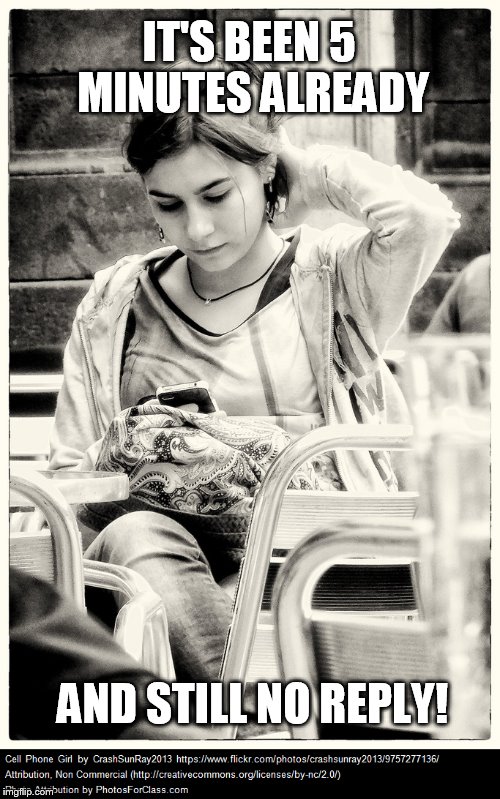
HATE TO WAIT

I chose to make this meme because I believe that it accurately reflects on digital natives. We live in a time now where all this information is at our fingertips WHENEVER we want it. Because of that, digital natives, myself included, have developed a sense of urgency when it comes to texting people and receiving a reply. It seems that people always have their cell phone and are almost always available to reach by text; so when it takes more than five minutes for a reply, different scenarios play out in our head about why this particular person hasn't responded. Digital immigrants (my parents) automatically assume I am, and I quote, 'dead in a ditch'.


Resources; Thomas, M. (Ed.). (2011). Deconstruction Digital Natives: Young People, Technology and the New Literacies. New York, NY: Routledge.

Wednesday, June 10, 2015

Digital Natives: Reflecting on the Myth


Forward:
"The idea of a technological or media-related generation gap is by no means new."-Professor David Buckingham (Thomas, 2011, p. ix)
This particular line stuck out to me because, honestly, it is something that I have never given any thought. With all this 'new' digital media out now, it is easy to forget that there has always been 'the next big thing' that the younger generation embraced while the older generation didn't necessarily. This progression can be traced back (even further) than to the invention of the television. There is constantly some type of new media that is evolving and a generation that is accepting it with open arms and a generation that is clinging to the past.


Chapter 1:
"The current generation of young people will reinvent the work place, and the society they live in. We have to get used to it, accept that the flow of knowledge moves both ways and do our best to make sure that no on is left behind."(Green & Hannon, 2007 n.p. as cited in Thomas, 2011, p.3)

This quote is particularly interesting to me because it nicely sums up exactly what is happening in our society today. My generation has changed so much from the one before it, and not just in the use of digital media, but in beliefs, in work ethic, and much more. The change that we see in the generation that comes after mine will be even greater I believe. I am interested to see how (if that is even possible) we, as a society, can work to make sure that no one is left behind in this whirlwind of change.


Chapter 2:
"Technology alone will not replace intuition, good judgment, problem-solving abilities, and a clear moral compass."-Marc Prensky (Thomas, 2011, p.18)

This quote grabbed my attention instantly because it is something that I preach from the front of the classroom, it seems, almost weekly! I continue to stress to my students the importance of having your own problem-solving skills, as well as the intuition and judgment on when/how to make your own decisions. I tell them a calculator, their cell phone, or even the Internet will not be responsible for them learning the material. Technology needs to be an aid in their learning, not the main essence of their education.


Chapter 3:
"A really big discontinuity has taken place. One might even call it a "singularity"- an event which change things so fundamentally that there is absolutely no going back" (Prensky, 2001a, p.1 as cited in Thomas, 2011, p 32)
I agree with this quote, a thousand times over. I truly believe that we have reached a 'point of no return' with our technology. We have made such great advances and expect it to be there and waiting for us at any given moment, that if we were forced to take one step back, most people would be lost. The internet connection goes out momentarily and some of us lose our minds! If a teenager is being disciplined, they aren't grounded anymore; they get their cell phone taken away. If you look on popular social media sites, it is common to see picture mocking what we do when the Internet is taken away from us. In our society today, I believe, that we couldn't function without it.


Has my thinking changed:

Has my thinking about the effects of technology on young peoples' abilities to think, learn, and socialize changed? Not necessarily. My thoughts have not so much changed as just built on the foundation that I already had. I thought from day one that technology is 'taking over and there is no turning back', so especially after reading the text, there is no way that I can say I have changed my stance. I don't think that technology is changing our ability to think, learn, and socialize; I think that it is changing our expectations of how we think, learn, and socialize. I can also say that I have increased my depth of knowledge in the realm of technology. For example, Digital Natives. I have learned this new term and have now given thought to a concept that I didn't even know existed.


    Digital Generation Gap

My visual metaphor represents what it means to be a digital native by illustrating the digital generation gap. A young couple (digital natives) with cell phones in hand, and an older gentleman (a digital immigrant) with a hard copy of a newspaper. The difference of this gap is evident in almost every public setting. If you see an older couple out to dinner, they are most likely just eating and talking. But, if you see a younger couple, or a group of teenagers out, it is almost a given that at least one of them will be on some type of digital device.


Resources:
Thomas, M. (Ed.). (2011). Deconstruction Digital Natives: Young People, Technology and the New Literacies. New York, NY: Routledge.

Saturday, June 6, 2015

Digital Media Effects on Conventional Reading and Writing Practices

Writing, she says, is “a plastic art.  Writing always changes given the context. It molds itself to the changes.”-Andrea Abernethy Lunsford (Karp)

I could not agree more with this quote. I feel like it really applies to me. In my life time, I have seen the changes in writing firsthand. I wrote before there were text messages, then I adjusted and learned how to text (something I fought at first), and now I am picking up on and using the new ways of writing and communication via texting. As our society has changed over the years, so has writing. And just like the quote says, it has kept up with our progression and molded itself to fit our needs.


From Literacy Debate: Online, R U Really Reading?
“It’s not on call at the touch of the finger. Learning is acquired mainly from books, and most readily from great books.”-David McCullough (Rich)

I disagree with this particular view on learning. I believe that it is possible to learn from other sources, digital sources including, instead of just a text book. I know that I've looked up a lot of stuff on line that I wanted to know, and now I know it. I taught myself how to change the oil in my vehicle and play harmonica by researching it online. I didn't have a book. And now those skills will be with me forever. Another example is this  Master's Degree we are all seeking. Yes, we have books to read from, but a lot of the information seems to be (so far) online articles, videos, and interacting with our colleagues via discussion board.


I see points and ideas that I agree and disagree with from both sides of the digital medial continuum. But, if I absolutely had to choose, I would say that I relate more closely to the Web Evangelist in the ways that I view digital media. I really do believe that our society is heading in the direction of being more and more technologically driven and it’s important that our students are able to keep up.

“There never was a golden age where everybody could write well,” says Lunsford. “Writing is hard.” (Karp) 
This quote helps my stance in showing that this new age of digital media isn't destroying our ability to read and write. The writing problem isn't something that just happened recently in the wake of all this new digital media; that problem has been around a long time.


From the second article, I pull this statistic and quote to back up my stance.
The simplest argument for why children should read in their leisure time is that it makes them better readers. According to federal statistics, students who say they read for fun once a day score significantly higher on reading tests than those who say they never do.
“Reading opens up doors to places that you probably will never get to visit in your lifetime, to cultures, to worlds, to people,”-Debroah Konyk    (Rich)

Both of these sayings are about reading. Neither of them refer strictly to a book in hand. Reading certainty does open doors to people, places, and things that a student might never actually see, so why limit that learning to just what is contained in one book at a time? Why not give them almost endless information about anything they could possible want to know? Digital media can take them to more places and they can see more people/things in a shorter amount of time.

I think that a nice balance between digital media and traditional books in education is a good thing for our students today.

                                                                                                               
The Continuous Progression of Writing


This picture represents where I think that writing and reading are headed. This is a picture of an ipad screen where Handwriting is an app. I think that we will continue to shy away from the traditional paper/pencil/paper book for 100% of learning.

I don't think that digital media will negativity effect young people's abilities to read and write. I think that young people will change the way that we read and write by their use digital media.


Resources:

Karp, J. (2010, January 26). Does Digital Media Make Us Bad Writers? | Spotlight on Digital Media and Learning. Retrieved June 6, 2015, from http://spotlight.macfound.org/featured-stories/entry/does-digital-media-make-us-bad-writers


Rich, M. (2008, July 26). Literacy Debate: Online, R U Really Reading? Retrieved June 6, 2015, from http://www.nytimes.com/2008/07/27/books/27reading.html?pagewanted=all&_r=0

Friday, June 5, 2015

Texting and Multi-modal Texts


After watch the TED talk above about the relationship between texting and language, I have a better understanding of both sides of the argument "is texting killing language?" I tend to lean more on the side of texting is taking away from communication, not necessarily language. I enjoyed the talk and I think that the video makes some excellent points that I have definitely not given any thought to.

The important things I learned from the video are
  • the idea that texting is the decline of the writing ability  of young people is not true,
  • that texting, called finger speech, allows us to write like we speak
  • and that a new structure of language is coming out of our texting habits
But the most important thing that I learned is that texting is actually allowing an expansion of our linguistic repertoire.


I teach college math, so a way that I might use Blabberize to support learning in my classroom would be to use it for a topic that many students don't like. For example, logarithms. It would be entertaining to use a Blabbeize to show the steps used when solving log problems. With the less serious presentation of the log information, perhaps it would stick in the students head better. Hopefully they won't think of logs and cringe.